 inthesingularity
F.002Increasingly Inexpensive Intelligence
From Napoleon III’s finest cutlery to a can we throw away: what aluminum’s collapse in price says about intelligence, and why the next era of AI winners will be the businesses that benefit from it.
In 1884, when the Washington Monument was set to be complete, aluminum was chosen as the material to cap the monument. At the time, aluminum typically cost $1.10/oz, the same price as silver. A 100 oz pyramid was cast and even displayed at Tiffany’s in New York City, to the amazement of thousands, prior to being shipped to DC. There were cost overruns and it ended up costing $2.25/oz to make this unprecedented point.
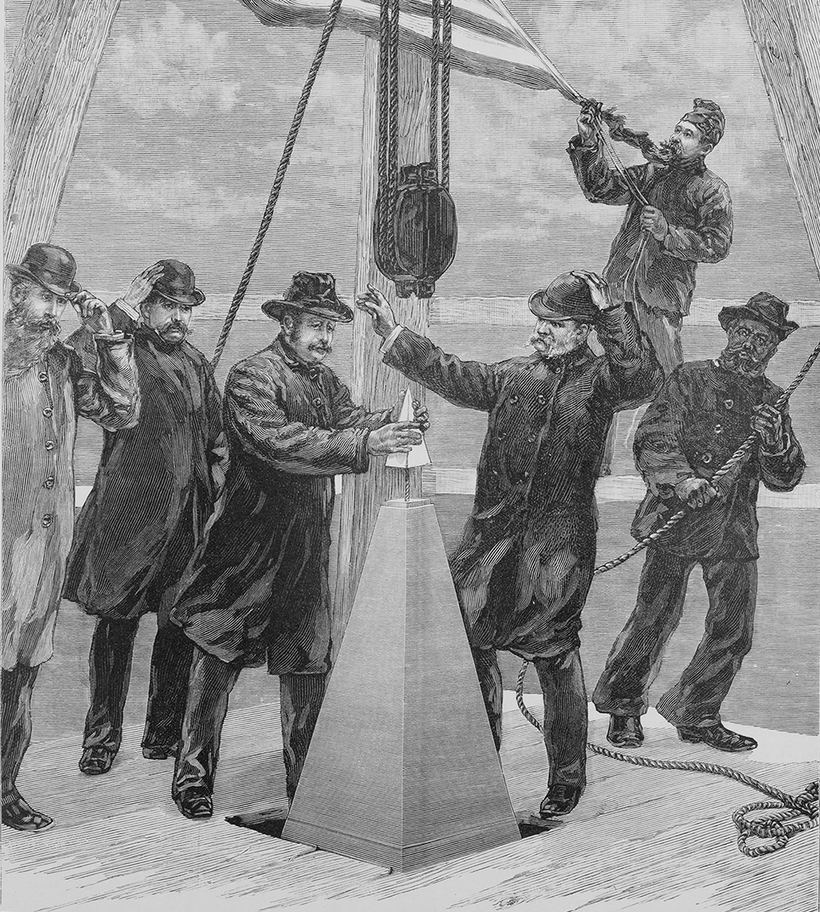
Two years later, Charles Martin Hall, at the age of 22, invented a new process for extracting aluminum via cryolite. It came out of necessity: aluminum is refined from alumina, which melts above 2,000°C, far too hot to run an electric current through. Hall found that molten cryolite, a mineral mined in Greenland that melts near 1,000°C, dissolves alumina, and that a current passed through the bath leaves molten aluminum at the bottom of the pot. Paul Héroult found the same process in France that year, which is why it carries both their names. This process cut the price of aluminum about 50-fold by 1900, and roughly 300-fold by the early 1970s after inflation, as production scaled.
Today the world produces about 74 million metric tons of aluminum a year. From Napoleon III using aluminum for his fanciest cutlery to a can we throw away. Much can be learned from aluminum.
From 3.6 tons a year to 74 million
World aluminum production, metric tons, log scale. Each gridline is 100 times the one below it.
1884–1898: contemporary estimates; 1900–2007: USGS; 2020 and 2025: International Aluminium Institute. 2008–2019 are not in the series (dashed).
Sitting here in 2026 those tuned into financial news hear of the price of tokens falling. How open source AI models are going to make AI so inexpensive there won’t be any use for all the data centers being built at the frontier. But … it is the reduction of cost that increases the demand. Token demand is skyrocketing with falling prices. And unlike aluminum where Hall’s discovery in 1886 is still largely used, AI is constantly improving itself. The cost of intelligence will likely fall exponentially faster. What companies pay for today on the frontier would be viewed as basic in the near future.
Some items, like gold or a Birkin bag, get their value from scarcity. But intelligence, my friends, is a frontier with unbounded demand.
We want to know how to cure our diseases, how to automate machines to do household chores, how to reduce car fatality rates by 90% and gain back billions of hours of time annually.
Returning to aluminum for a moment. From a novelty to a building block of society. From luxury and awe to industrial and trash. Our timeline is advancing much faster than the 1880s aluminum scaled, though what the next decade and century brings is likely an order of magnitude beyond our comprehension.
The next decade will see a constant contrast of falling prices of intelligence with greater volumes and applications. Many winners and losers, timing each cycle will be critical. The component layers or application layer, robotics and self-driving vehicles, frontier or open source, hyperscalers vs neoclouds, and so many industries which don’t even exist yet.
The key thing to keep in mind:
falling prices = greater demand = larger total addressable market
OpenRouter, which allows enterprise AI consumers to choose the most cost-effective model, has seen token demand rise about 30-fold this year, while the average token price has fallen about 40%. Spend is up about 18-fold.
Price per token down 41%, spend up 18-fold
OpenRouter, seven-day averages, first week of January 2026 = 1, log scale, through Oct 13. Spend is estimated at each model’s list price; free tokens count at $0 in the average price.
The average token price decline does not tell the full story. For example, in February 2026, Anthropic’s Opus 4.6 was the frontier model. Today you can run OpenAI’s GPT-6 Luna, which BenchLM.ai ranks higher, for 2% of the cost of Opus 4.6.
A higher score for 2% of the price
| Model | Released | BenchLM score | Price per M tokens, in / out |
|---|---|---|---|
| Claude Opus 4.6Anthropic | Feb 2026 | 61.2#47 of 220 | $5.00 / $25.00 |
| GPT-6 LunaOpenAI | Sep 22, 2026 | 65.3#33 of 220 | $0.10 / $0.50 |
BenchLM.ai model pages, October 2026. Scores are out of 100.
Frontier-priced intelligence, models at $4 or more per million tokens, peaked at 61% of spend on OpenRouter in July 2026 and now is 27%. Mid-tier intelligence demand is advancing rapidly. According to a recent MIT paper titled “The Price of Progress: Price Performance and the Future of AI” the effective price decline is 5 to 10x per year depending on the task. Fast forward 2 years and that would suggest we could see the cost of intelligence fall by 96% to 99%. Imagine a decade. The frontier will continue to advance, be distilled. Efficient mid-tier models will emerge.
Spend is moving down from the top price tier
Share of estimated OpenRouter spend by the model’s blended list price per million tokens (see method), 30-day average. Premium is $4 and up, mid-tier $1.50–4, economy $0.20–1.50 and ultra-low under $0.20. Part of the shift is repricing: Claude Opus 5.5 and GPT-5.6 Sol come in just under $4, so they count as mid-tier.
The big money made thus far in the public market for the AI trade has been the components of the data center. GPUs, memory, optics, CPUs, and the companies which package these items on various levels.
The next era of AI winners will not be the production of intelligence, but who benefits from increasingly inexpensive intelligence.
It will not be the person who makes the aluminum for scaffolding, it will be the builder of the skyscraper.
Long-term winners from increasingly inexpensive intelligence:
- Companies facilitating enterprise build out of custom LLMs and intelligence platforms (without information leakage to the big models)
- Profit margins of AI adapting enterprises
- Companies where digital shopping experiences matter
- Self-driving cars & robots
- Personalized healthcare & drug discovery
Follow-up: F.003, a case study of Rocket Companies, the largest US mortgage servicer, looks for these savings in one company’s numbers.
Disclosure: This is for informational purposes only and is not investment advice or a recommendation to buy or sell any security. Figures come from the sources below, believed reliable but not guaranteed. Opinions may change.
Sources and method
The monument: the price of aluminum in 1884, the 100-ounce point and the Tiffany’s display are from the National Park Service and the National Archives’ Prologue, which gives the agreed price of $100 and Frishmuth’s $225 bill. The engraving is from Harper’s Weekly, December 20, 1884, via the Library of Congress.
Prices: the 50-fold drop compares $1.10 an ounce in 1884 with the USGS average unit value of $721 a metric ton in 1900, about 33 cents a pound. The 300-fold drop compares the same 1884 price with USGS unit values of $633 a ton in 1970 and $551 in 1972, deflated to 1884 dollars with the Minneapolis Fed’s historical CPI: 265-fold and 328-fold.
Production: 1884–1898 from History of aluminium (contemporary estimates); 1900–2007 world production from USGS Data Series 140; 2020 (65.3 million tons) and 2025 (73.8 million tons) are International Aluminium Institute primary production.
OpenRouter: daily tokens by model from OpenRouter, priced the way inthesingularity.ai’s OpenRouter tracker prices them: each model’s list price that day, with 10% of tokens as output and about half of input billed at the cached rate. Free variants count at $0. Price tiers use that blended price per million tokens. The long tail, models outside OpenRouter’s top 50 and the few without a listed price, is priced at the day’s average and shown separately. Data through October 13, 2026.
Models and research: scores, ranks and prices from BenchLM.ai model pages. Hans Gundlach, Jayson Lynch, Matthias Mertens and Neil Thompson, “The Price of Progress: Price Performance and the Future of AI”, MIT FutureTech, arXiv:2511.23455: prices at a fixed level of performance fell about 5 to 10x a year on knowledge, reasoning, math and software engineering benchmarks.